

A signed title transfers ownership of a car. A bill of sale for vehicle sales records everything the title leaves out. That means the date, the price, the mileage, and both names attached to the deal. That second piece of paper is what settles arguments six months later. Most states will process a title transfer without one. Almost none will help you afterward if you cannot show what you actually agreed to.
Short answer: Write down the year, make, model, and VIN, the sale date, the exact price, both names and addresses, the odometer reading, and an as-is line. Both parties sign, both keep a copy, and the seller files whatever notice of transfer the state requires. Notarising is optional in most states.
Key takeaways
- Seven fields carry the whole document, and a missing VIN is the one that voids it.
- The title transfers ownership. The sale record proves the terms of the transfer.
- Notarising is required in a minority of states and harmless everywhere else.
- Odometer disclosure is federal, and newer cars stay covered for two decades.
- Telling your state you sold the car is a separate filing with its own clock.
The seven fields every vehicle bill of sale needs
Blank templates look interchangeable. They are not. Any form that omits the VIN or the odometer reading fails at the moment you need it. That moment is usually a title clerk’s counter or a small claims hearing.
| Bill of Sale for Vehicle Field | What to Write | Why It Matters |
| Vehicle identification | Year, make, model, body style, and the full 17-character VIN | The VIN is the only field that identifies one specific car. Everything else describes thousands. |
| Sale price | The exact figure in dollars, written in numerals and words | Your state calculates sales tax from this number, and a vague figure invites a review. |
| Sale date | Month spelled out, for example March 4, 2026 | Liability shifts on this date. Tickets and tolls before it are yours. |
| Buyer and seller details | Full legal names, street addresses, and ZIP codes for both | A first name and a phone number are not a party to a contract. |
| Odometer reading | The exact mileage at handover, plus a note if it is not actual | Federal law treats a false reading as fraud, not a clerical slip. |
| Condition terms | An as-is clause, or the specific warranty you are offering | Silence here is what buyers point at when the transmission goes. |
| Signatures | Both parties sign and print, on the same date | An unsigned copy is a note, not an agreement. |
What a Bill of Sale for a Vehicle Does That the Title Does Not

The title is the state’s ownership record. Transferring it is what makes the buyer the owner. A bill of sale for a vehicle is private evidence between two people that documents the terms of the transaction, but it does not replace the title. States are blunt about this limit.
So the answer to “can I sell a car with just this form” is usually no. If the title is lost, apply for a duplicate before you list the car rather than after a buyer is standing in your driveway with cash. Sellers tend to underprepare the listing itself at that same stage. Our piece on how many photos to include when you sell a car online covers the count that moves a private listing.
California takes the loosest position of the states we checked. Its DMV manual accepts any bill of sale that identifies the vehicle, with REG 262 offered as the official version.
How to write a bill of sale for vehicle transfer, step by step
What you’ll need: the title, a current odometer photo, both parties’ driver’s licences, and either your state DMV’s form or a blank sheet. Two pens beat one.
- Download your state’s form first. Roughly half of state agencies publish one, and using it removes any argument about whether your version is acceptable.
- Copy the VIN off the dashboard plate, not the listing. Read it against the title, character by character, before anyone signs.
- Photograph the odometer on the day of sale. Attach the reading to the form and keep the image with your copy.
- Write the agreed price in full. Round numbers look invented, so record what changed hands, including any deposit paid earlier. Used values move fast, as anyone tracking used prices for an iPhone 14 Plus will recognise—price from current listings, not memory.
- Name the payment method. Cash, cashier’s check, or transfer, with the last four digits of the check number if there is one.
- Add the as-is sentence. One line does it: sold as is, where is, with no express or implied warranty.
- Sign together, in front of each other. Print names underneath so a clerk can read them.
- Make two copies before you part. The buyer takes one to the DMV; the seller keeps one until the title clears.
Eight steps, ten minutes. Every version that fails was written afterward, from memory.
Does it need to be notarized?
Several states do require notarization for private vehicle transfers, and the list shifts, so treat any blog table of all fifty as out of date. Louisiana is the instructive case. It has a long notarial tradition. Even so, its own motor vehicle policy dropped the notarization requirement for dealer sales made on or after January 1, 2023. That policy also treats a separate document as unnecessary in a private sale when the price is included in the title assignment.
Check your own state agency’s title transfer page before you book a notary. If you cannot get a clear answer in five minutes, notarize anyway. A mobile notary typically charges $5 to $25, and no state has ever rejected paperwork for being too well witnessed.
State rules that genuinely change the answer
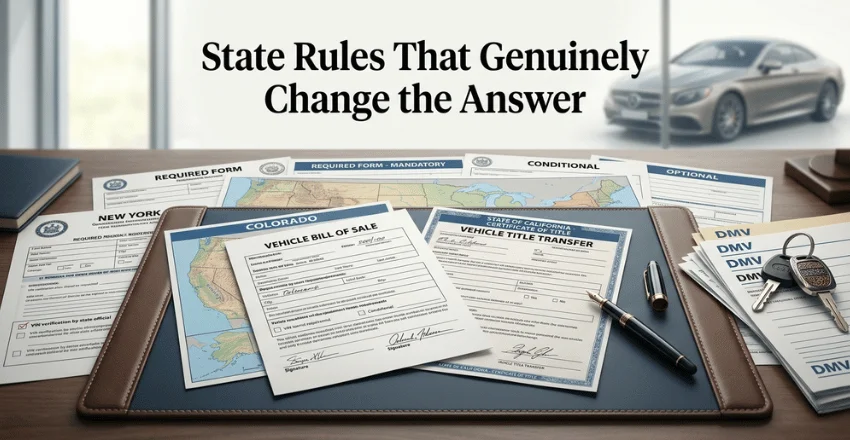
State variation is the whole topic here, so here is what we confirmed directly with the agencies rather than repeating. New York requires one. Its DMV instructs the seller to sign form MV-912 and hand it to the buyer, even when the car is a gift. That title’s completed transfer section goes with it.
Washington takes a conditional line. Its Department of Licensing tells both parties to sign one unless the sale price and date already appear on the title. Each of them keeps a copy. Those three positions, mandatory, conditional, and permissive, cover most of what you will meet. When the buyer and seller live in different states, the buyer’s state controls, because that is where the car gets titled. Ask the buyer which agency they will file with and match its form.
The odometer line is federal, and it lasts longer than you think.
Mileage is the one entry on the form that federal law reaches into. The old habit of writing “exempt” on anything older than ten years no longer holds for most cars on the road. According to 49 CFR 580.17, the federal rule, a 2010 or earlier model is exempt once transferred at least 10 years after January 1 of its model year. A vehicle of model year 2011 or later stays covered for 20 years. In practice, a 2011 model sold today still needs a disclosure, and it will until 2031.
Write the reading as it appears. If the cluster has been replaced or the digits have rolled over, say so on the form. A knowingly false statement here is federal odometer fraud, and the buyer’s remedy is money out of your pocket.
After the handover: cutting your liability

The buyer now has the car. You are still, in the eyes of most state databases, the registered owner until someone tells the state otherwise. Parking citations, toll charges, and towing bills follow the registration.
Washington shows how seriously agencies treat this. According to guidance published by the state’s Department of Licensing, sellers must file a report of sale within 5 days for $18. The agency states that filing protects the seller from towing charges and from civil and criminal liability incurred by the new owner. Other states call the same filing a notice of transfer or a release of liability. Deadlines usually fall somewhere between 5 and 30 days.
Two other loose ends deserve a calendar reminder. Remove your license plates if your state keeps plates with the seller, and cancel insurance only after the transfer shows as complete. If money is still owed on the car, the lender holds the title and nothing moves until the loan is settled. This guide to your rights under a car finance agreement is worth reading first.
Your next step
Open your state motor vehicle agency’s title transfer page, search it for the word “sale”, and download the form if one exists. Fill in the seven fields from the table above tonight, before the buyer arrives, and leave only the date, mileage, and signatures blank. Ten minutes of preparation is what keeps a private sale from following you home.
Frequently asked questions
Yes, once both parties sign it. It is a contract recording a completed sale, and courts treat it that way. It still does not transfer title on its own.
Both of you keep a signed copy. The buyer usually needs theirs at the title counter, and the seller wants theirs if a citation arrives later.
It tells the buyer they are accepting the car’s current condition with no warranty. It does not protect a seller who hid a known defect, since misrepresentation is a separate problem.
Yes, in most states, as long as all seven fields are there and both parties sign. A handwritten page with a VIN beats a printed template without one.
Often yes. New York asks for MV-912 even when the price is zero, because the state still wants a dated record of who handed the car to whom.
Keep it at least until the title shows in the buyer’s name, and ideally for three to four years. Tax questions and toll disputes surface late.