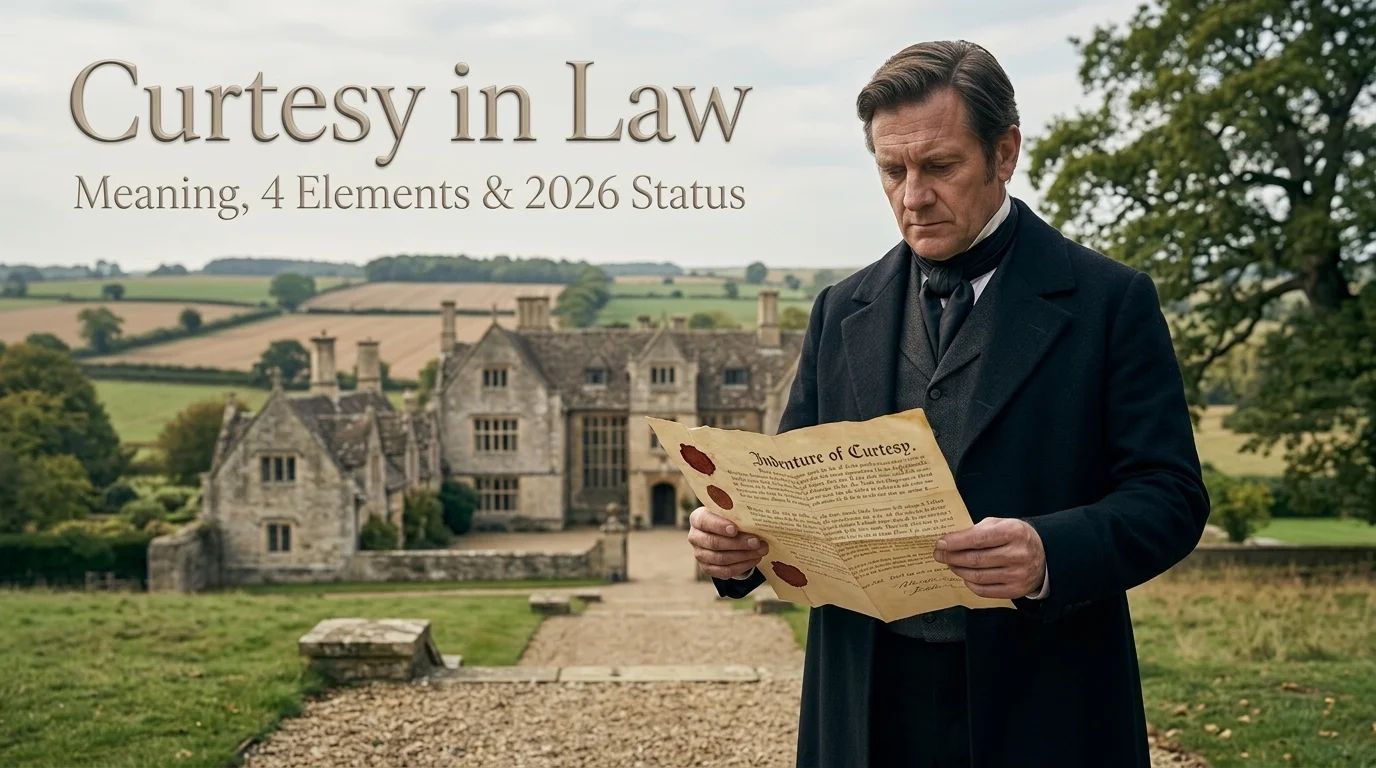
Curtesy is a common-law rule that lets a widower keep his late wife’s land for the rest of his own life. It is not a misspelling of courtesy, though that is how most readers reach the word. Almost every state has scrapped the doctrine by statute. Yet the label survives in probate files, title abstracts and exam questions, so it still pays to know what it meant.
Short answer: a husband could hold his wife’s freehold land for life after she died, but usually only if she had borne a living child during the marriage. His interest ended at his own death and passed nothing to his heirs. Modern statutes replaced the rule with a gender neutral elective share.
| Quick question | Answer |
|---|---|
| What kind of interest was it? | A life estate in land, not outright ownership |
| Who could claim it? | The surviving husband |
| Usual condition | A child born alive during the marriage |
| Female counterpart | Dower, the widow’s one-third life estate |
| Property covered | Real property only, never cash or goods |
| Status in 2026 | Abolished or rewritten in nearly every state |
| Modern stand in | The statutory elective share |
TL;DR
- The doctrine gave a widower a life estate in his wife’s land after her death.
- Four elements had to line up: marriage, her ownership, a living child, and her death first.
- Dower was the mirror-image right for widows, usually limited to one-third.
- Nearly every state ended the interest and swapped in a gender neutral elective share.
- Arkansas and Kentucky still use the old vocabulary in their statutes.
- You will meet the word most often in title work, old deeds, and genealogy records.
Curtesy, courtesy, or curtsy?
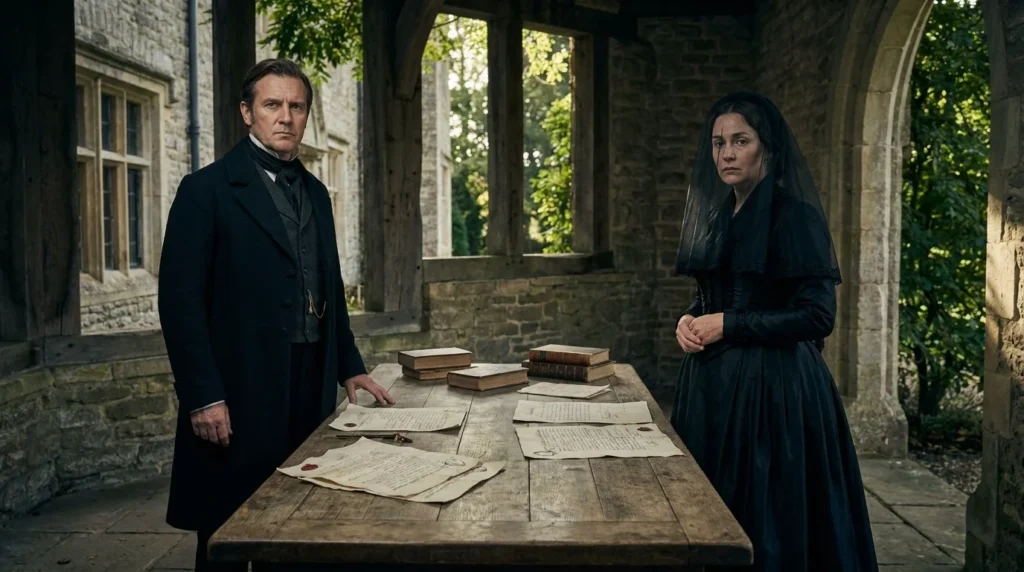
Three words sound close and mean nothing alike. Courtesy is politeness, as in a courtesy call or a free upgrade offered as a courtesy. Curtsy names the small bow made by bending the knees. Between them sits the legal term curtesy, spelled with an e in the second syllable and no second o. All three trace back to the same Old French root for the manners of a royal court. English lawyers borrowed it because the right was said to exist by the courtesy of England, then the spelling drifted. That shared ancestry explains why spellcheckers rarely flag the swap and why search engines see so many mixed-up queries. For a closer look, see The Ultimate Guide To Public Relations.
Guessing an unfamiliar term from how it sounds usually goes badly, whether the source is a probate file or a group chat. We take the same plain approach in our explainer on what the slang phrase FAFO means. A wrong guess there costs you a joke. A wrong guess here costs you a property answer.
The four elements a widower had to prove
Courts did not hand the interest to every husband who outlived his wife. Four conditions had to be satisfied, and losing any one of them sank the claim.
- A valid marriage. The couple had to be lawfully married when the wife held the land.
- Her ownership of an inheritable freehold. She had to be seized of land that her heirs could inherit, so a life estate of her own was not enough.
- A child born alive. The marriage had to produce issue capable of inheriting the land, and the baby had to draw breath. A stillbirth defeated the claim, and the child did not have to survive.
- The wife dying first. Only her death set the interest running.
According to the Legal Information Institute at Cornell Law School, a qualifying widower took a life interest in 100% of his wife’s freehold land. That same Institute records the doctrine as replaced by equal treatment regardless of gender. Compare that with the one-third a widow received. The old rule was never a two-way street.
How the widower’s right compared with dower

Students mix up the two constantly, and the differences are easy to hold once you see them side by side.
| Feature | Widower’s life estate | Dower | Elective share today |
|---|---|---|---|
| Who benefits | Surviving husband | Surviving wife | Either spouse |
| Share | All of her qualifying land | One third of his land | Often one third of the estate |
| Condition | A living child of the marriage | None beyond the marriage | None beyond the marriage |
| Property reached | Real property | Real property | Real and personal property |
| Duration | Life of the survivor | Life of the survivor | Outright, not for life |
Notice the asymmetry. A widow got a third and no test to pass, while a widower got everything but had to show a child. Land was all either interest ever touched. That made them powerful in a farming economy and nearly pointless once wealth moved into stocks, pensions, and bank accounts.
Which states still carry the old label
Very few, and none of them apply the medieval version. Arkansas keeps a probate chapter whose heading still names both of the old interests. Its operative language now speaks of a surviving spouse rather than a husband or a wife. Kentucky does something similar: its statute on spousal interests states that any reference in state law to those historic labels means the interest that section creates.
Virginia went the other way and said so bluntly. According to the Code of Virginia, published by the Virginia General Assembly, the interests of dower and curtesy are abolished. That abolition took effect on January 1, 1991, and it spared interests already vested. Most states passed comparable laws across the twentieth century, many of them prompted by equal protection challenges to rules that treated husbands and wives differently.
Do not assume your state from a list you found online, including this one. Statutes get renumbered, and a savings clause for interests that vested decades ago can still decide a live title dispute. Read your own state’s probate code, or ask an estate attorney to read it for you.
What replaced the doctrine

Statutory elective shares did most of the work. In common-law property states, a surviving spouse who dislikes the will can renounce it and claim a fixed slice of the estate instead. One third is the classic figure, so a $600,000 estate yields a claim near $200,000. States following the Uniform Probate Code scale that share by how long the marriage lasted, so a forty-year partnership earns far more than a two-year one.
Nine community property states never needed the fix. In Arizona, California, Idaho, Louisiana, Nevada, New Mexico, Texas, Washington and Wisconsin, each spouse already owns half of what the couple earned during the marriage. Homestead rights, family allowances and exempt property statutes fill the remaining gaps in most states.
The practical lesson holds well beyond probate: a right you never read about is a right you cannot use. That is the same reason we walk through your rights in car finance claims and PCP agreements, where the paperwork quietly decides who owns what.
Why the term still turns up today

Three settings keep curtesy alive. Title examiners meet it first. A deed signed in 1930 may recite a release of dower plus a matching release by the husband, and a missing signature can cloud the chain of title. Probate lawyers meet it second, usually in a savings clause that preserves interests vested before the abolition date. Genealogists meet it third. Old county records list these interests by name, and they reveal marriages, births, and death dates that no census page records. A researcher who reads the word as courtesy will misread the whole document.
Language keeps words long after their jobs disappear, which is exactly what happens with phrases that outlive their moment. Our piece on the meaning behind the phrase oi oi oi baka follows the same pattern online. A term travels far past the context that produced it.
Your next step
If this word reached you through a real estate file or a probate matter, do not stop at the definition. Pull your state’s elective share statute, note the deadline for filing the election, and check whether a savings clause preserves anything from the old regime. Then take that reading to an estate attorney before you sign, waive, or record anything.
FAQs
Not in its common-law form. A handful of states keep the vocabulary in their statutes, but the modern versions apply to either spouse and look nothing like the original rule.
No. It reached real property only. That limit is the main reason the doctrine stopped protecting widowers once household wealth shifted into savings and retirement accounts.
His claim survived. The child only had to be born alive and capable of inheriting, so a death days later did not defeat the husband’s interest.
A small number of states retain a statutory version, and Ohio is the example most often cited. Everywhere else, the elective share governs.
Search your state code for the words dower, elective share, and spousal share together. State legislature websites publish the current text for free.