
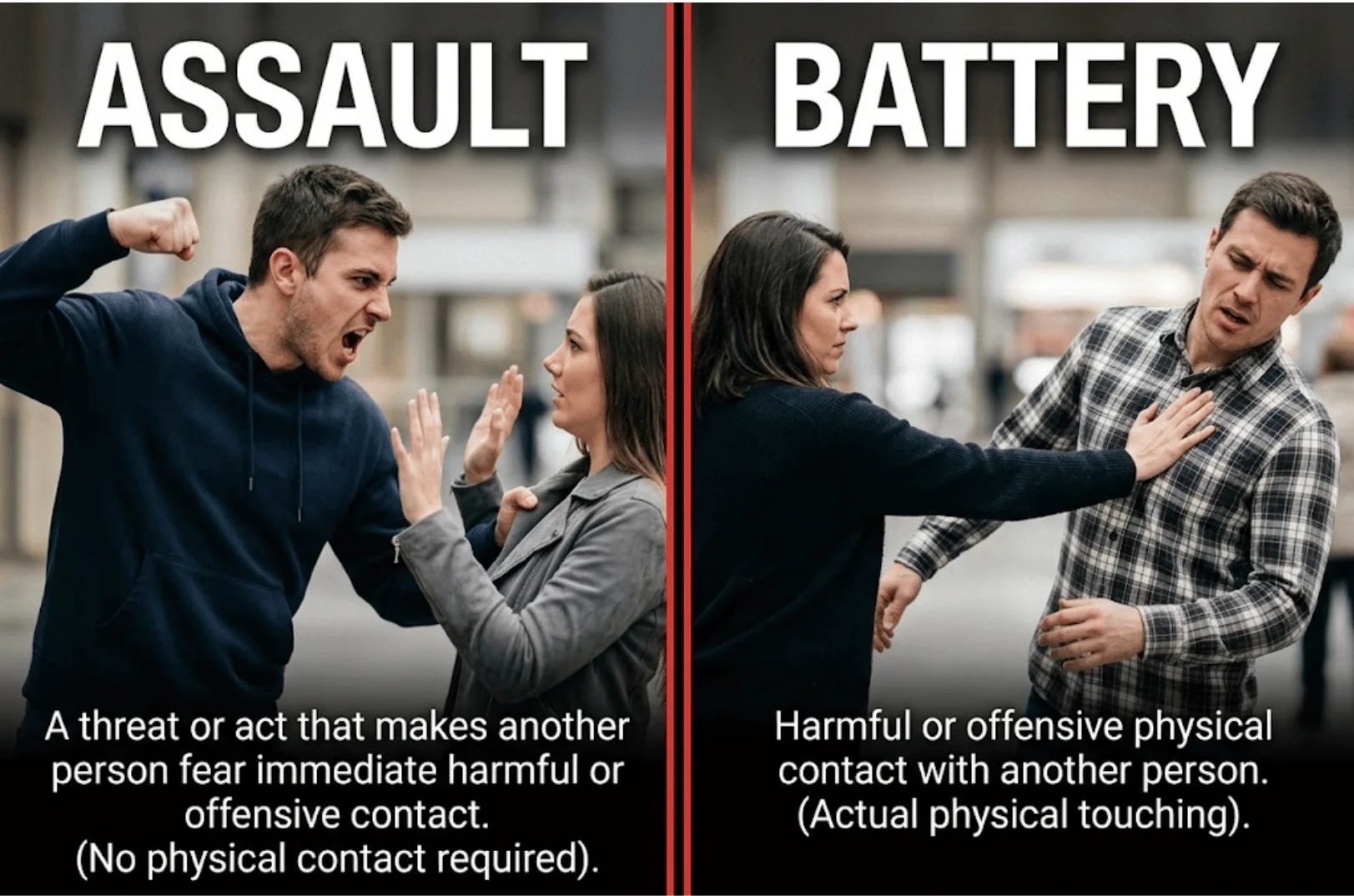
Two words get used as one phrase on TV, in headlines, and in bar arguments. In a courtroom, they can mean two very different things, or one thing, depending on which state you are standing in. Here is the split, and why the label on the charging document may surprise you.
The short answer: what’s the difference between assault and battery comes down to contact. One term traditionally covers the threat, the moment you reasonably fear you are about to be hurt. The other covers the follow-through, the unwanted physical contact itself. Many states have since folded the two together under one name.
The two terms side by side
| Attribute | Assault (classic sense) | Battery (classic sense) |
|---|---|---|
| What it punishes | The threat of imminent harm | The harmful or offensive contact |
| Physical contact required | No | Yes, even slight contact counts |
| Injury required | No, fear is enough | Not always; offensive touching can qualify |
| Classic example | Raising a fist and swinging at someone who ducks | Landing the punch, or spitting on someone |
| Criminal side | Usually a misdemeanor unless a weapon is involved | Misdemeanor; felony if injury is serious |
| Civil side | An intentional tort, damages for fear and distress | An intentional tort, damages for injury and harm |
| Who brings it | A prosecutor, or the injured person in civil court | A prosecutor, or the injured person in civil court |
TL;DR:
- Classic rule: one offense is the threat, the other is the touch.
- Both grew out of English common law, and both survive in US courts.
- Roughly half of states have merged, renamed, or reshuffled the pair.
- The same incident can result in both a criminal case and a separate civil lawsuit.
- Aggravated versions add a weapon, a serious injury, or a protected victim.
- Only your own state code settles which word applies to your situation.
Where the split came from
English common law needed a way to punish fear, not just wounds. A person who lunged at you with a knife and missed had still done something the law wanted to reach. So one wrong covered putting you in reasonable apprehension of immediate harm, and a second wrong covered the contact that followed.
American courts inherited both, and the old logic still shows up in jury instructions. The threat offense protects your peace of mind. The contact offense protects your body. That is why prosecutors can stack both counts from a single fight: the wind-up and the landing are legally separate events.
Public examples make the second half easy to picture. The 2022 Oscars slap was textbook unwanted contact: deliberate, uninvited, and witnessed by millions. No criminal case followed, because Chris Rock, whose daughters now have careers of their own, declined to press charges. Prosecutors rarely move without a cooperating victim.
What’s the difference between assault and battery in your state?
This is where the tidy textbook answer breaks down. Each state writes its own criminal code, and the words drift. Two real statutes show how far apart the labels can sit.
Louisiana kept the old structure. According to the Louisiana State Legislature’s published code text, which was current in 2026, Revised Statute 14:36 covers an attempt to commit battery. It also covers intentionally placing someone in reasonable apprehension of receiving one. No touching is required.
New York went the other way. Its code has no crime called battery. Penal Law section 120.00, published by the New York State Senate and current in 2026, sets out third-degree assault. A person is guilty when, intending to cause physical injury, he causes that injury. That is a class A misdemeanor. Here the word covers exactly what Louisiana would call the contact.
Other states run a third pattern, charging “assault and battery” as one combined offense. So the honest answer to a definition question is that the label depends on the code for the location of the incident. Before you rely on any general explanation, including this one, pull up your own state’s statute by number on the legislature’s website and read the operative sentence.
Aggravated versions raise the stakes
Most states keep a base offense and a more serious tier. The upgrade usually turns on one of four factors.
- A weapon. A gun, a knife, or an object used as one moves the case up sharply.
- The injury. Bruising is treated very differently from a broken bone or permanent damage.
- The victim. Police officers, paramedics, teachers, children, and older adults often trigger enhanced tiers.
- The intent. Contact meant to cause serious harm outranks a reckless shove.
The practical result is large. A base misdemeanor might mean a fine, probation, and an anger management class. An aggravated felony count can carry years of prison exposure, and in many states it counts as a strike for future sentencing. The gap between the two tiers is usually wider than the gap between the two classic terms.
One incident, two courtrooms

People often assume a criminal case is the only route. It is not. Both wrongs also constitute intentional torts, which means the injured person can file a private lawsuit for damages. The two tracks run on different rails.
| Question | Criminal case | Civil claim |
|---|---|---|
| Who decides to file | The prosecutor | The injured person |
| Standard of proof | Beyond a reasonable doubt | A preponderance of the evidence |
| Possible outcome | Jail, probation, fines, a record | Compensatory and sometimes punitive damages |
| Deadline to start | Statute of limitations, often several years | Often one to three years, shorter than you expect |
| Effect of an acquittal | Case over | The civil claim can still succeed |
That last row surprises people. A jury can refuse to convict, and a civil jury can still award damages over the same punch, because the civil bar is lower. You only need to show the version of events is more likely true than not. Awards swing wildly, too, from a nominal $1 that mainly makes a point to six figures, where the injuries last.
What usually does not count
Not every unpleasant encounter fits either category. Three limits do most of the work.
Words alone are rarely enough. A shouted threat across a parking lot generally fails because the fear must be of immediate harm, and the speaker must have an apparent present ability to deliver it. A threat to hurt you next month is a different offense in most codes, if it is one at all.
Consent changes the analysis. A boxer who signs up for a bout consents to punches inside the rules. A surgeon with informed consent is not committing a tort by cutting. Step outside the agreed scope, and the protection disappears.
Animals are a separate branch. A dog cannot form criminal intent, so a bite is handled under negligence or a state dog bite statute, not as an intentional wrong by the animal. Owner liability is its own topic, and it is worth understanding before choosing a dog and a local trainer, since training records often surface in those claims.
What a conviction costs after the case
Sentences end. Records do not. A violence conviction shows up in background checks for jobs, apartments, and professional licenses, and some states restrict firearm rights permanently. Immigration consequences can be severe for non-citizens, even on a misdemeanor plea.
People do rebuild. Plenty of public figures have turned time served into a career, and how Wes Watson built his net worth after prison is one widely followed example. Still, the smoother path is the one that never reaches sentencing.
If you are facing a charge or thinking about a civil claim, do two things this week. Read the exact statute you are accused of breaking, by section number, on your state legislature’s own site. Then talk to a licensed criminal defense or personal injury attorney in that state before you give any statement. This article explains the concepts; only a lawyer who reads your file can advise you.
Frequently asked questions
One is the threat that makes you flinch. The other is the contact that lands. Some states use a single word for both, so read the code, not the headline.
Yes, in states that keep them separate. Swinging and connecting can support two counts, though sentences often run together rather than back-to-back.
Usually the contact offense, because real injury is easier to prove and punish. A threat made with a loaded gun can outrank a shove, so the facts matter more than the label.
Yes. A civil claim is yours to file and is subject to a lower standard of proof. Watch the filing deadline, which is often shorter than the criminal one.
Rarely as an immediate threat offense, since there is no present ability to act. It may fit harassment, stalking, or terroristic threat statutes instead.
It signals an enhancing factor: a weapon, serious injury, or a protected victim. It moves the case from misdemeanor territory into felony exposure.