Apple no longer sells the iPhone 14 Plus new, and its Certified Refurbished store does not stock this model either. Every route to one now runs through somebody else’s inventory. Prices have settled into a narrow band, and the software runway is longer than most shoppers assume.
| Detail | Where it stands in August 2026 |
| Released | October 7, 2022 |
| Sold new by Apple | No, and not on Apple Certified Refurbished either. |
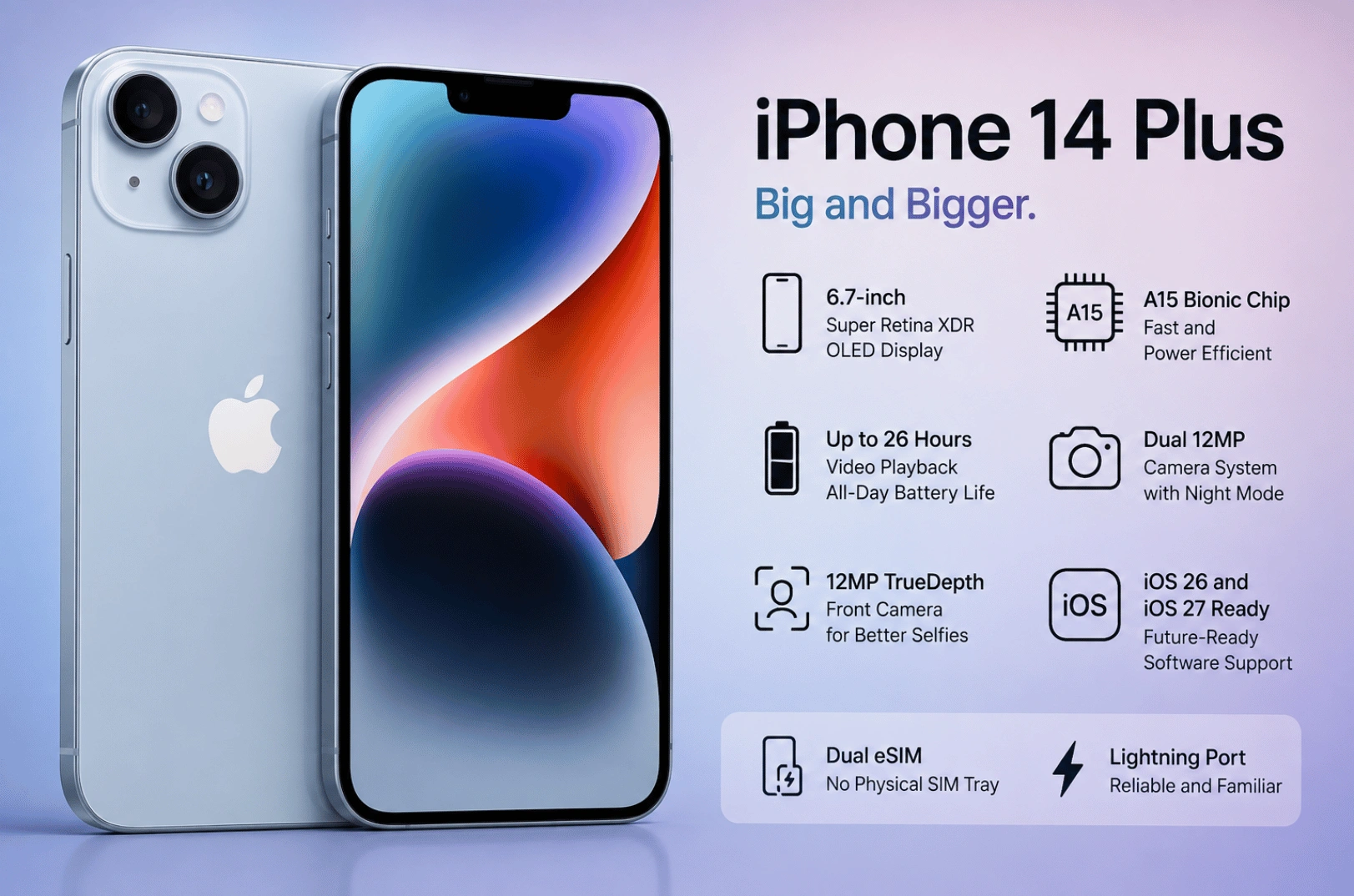
| Screen | 6.7-inch OLED, 2778 by 1284 at 458 ppi, 800 nits typical |
| Chip | A15 Bionic, 6-core CPU, 5-core GPU |
| Cameras | 12MP main, 12MP ultra-wide, 12MP front |
| Battery rating | Up to 26 hours of video playback |
| Charging port | Lightning |
| SIM | Dual eSIM, no physical SIM tray on US units |
| Latest software | iOS 26 is now confirmed for the fall. |
| Apple Intelligence | Not supported |
| Typical US used price | $248 to $433 depending on storage and grade |
Key Takeaways
- A clean 128GB unit costs roughly $280 to $360 right now.
- The screen and battery still hold up. The chip, port, and camera do not.
- Apple has confirmed iOS 27 for this model, so the update runway is real.
- Apple Intelligence will never arrive on it, at any iOS version.
- Budget $79 plus $6.95 shipping if the battery is worn.
What a used iPhone 14 Plus costs right now
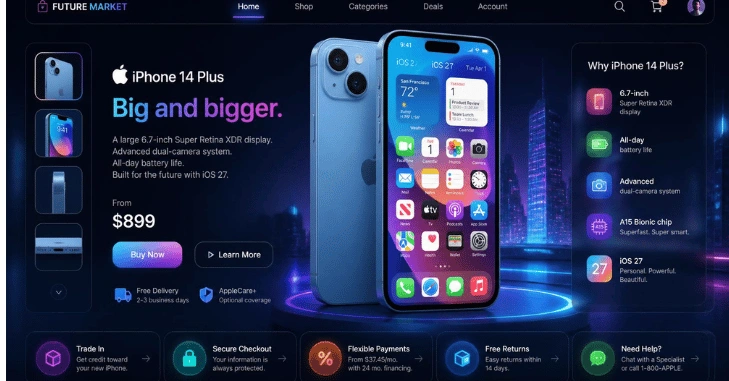
Three US marketplaces set the going rate. I checked all three on August 9, 2026: iPhone 14 Plus. Price gaps are small enough that shopping around saves you forty dollars, not two hundred. Pick the seller whose returns policy you trust, rather than chasing the lowest listing on the page.
| Where | 128GB | 256GB | 512GB | What you get |
| Swappa | $333 average, from $248 | $389 average | $433 average | Private sellers, no warranty, mostly unlocked stock |
| Back Market | $312 to $357 | $335 to $391 | $362 to $491 | Graded Fair, Good, or Excellent by the seller |
| Gazelle | $277 to $338 | $317 to $395 | $350 to $425 | 55-point inspection, free 30-day returns |
Carrier locking moves the number more than condition does. An AT&T 128GB unit averages $308 on Swappa against $335 for the unlocked version, so the locked discount is thinner than the hassle deserves. Verizon has pulled its product page entirely and points shoppers at certified pre-owned stock instead.
Put that against your running costs before you decide. One San Jose cost-of-living breakdown puts the average cell phone bill at $127.37 a month. Your plan will outspend this handset inside three months.
Software: iOS 26 Today, iOS 27 This Fall
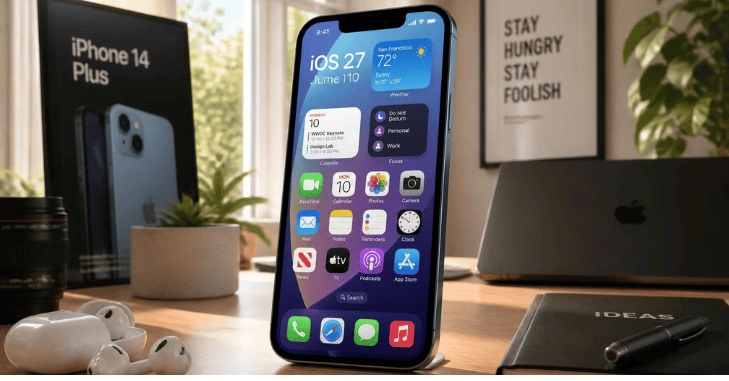
Shoppers get this part wrong in both directions. The phone is not abandoned, and it is not future-proof. The iPhone 14 Plus remains supported in 2026, running iOS 26 with iOS 27 confirmed for this fall. This gives buyers another major software update to look forward to, although the phone is not future-proof. Apple’s newer features and capabilities are increasingly designed around newer hardware, so the iPhone 14 Plus may not receive every feature available on the latest models. For buyers who mainly need reliable performance, security updates, apps, messaging, streaming, and everyday tasks, its current software support still makes it a practical used-phone option.
How Long Do The Updates Last
Apple listed this model among the devices compatible with iOS 27, which ships as a free update this fall. Nothing that ran iOS 26 got dropped from the list. That covers you for the next full release cycle at minimum.
Past that, the published floor is five years of security updates from the first supply date, a commitment Apple made in a UK product security declaration. This handset first shipped in October 2022, so that floor lands in late 2027. In practice, Apple has run well past its own stated minimum for years.
What You Will Never Get
Apple Intelligence needs an iPhone 15 Pro or an iPhone 16 and later. No software update changes that. If Siri summaries, writing tools, and image generation matter to you, this phone is the wrong purchase at any price.
Battery, screen, and everyday speed
The battery is why this model exists.
Apple rates it for up to 26 hours of video playback. That 4,323 mAh cell is one of the largest ever fitted to a non-Pro Max iPhone. Even at 85% health, a four-year-old unit clears a normal day of messaging, maps, and streaming without a top-up at lunchtime.
When health drops below that, replacement is cheap. Apple charges $79 plus $6.95 shipping for an out-of-warranty battery service, and that flat rate covers the whole iPhone line. Now the screen. It is a 6.7-inch OLED at 458 ppi with 800 nits of typical brightness. There is no ProMotion, so scrolling runs at 60Hz and looks less fluid beside a current iPhone 17. Outdoors,s it is dimmer than anything Apple ships today.
Speed is a non-issue for ordinary work. The A15 handles messaging, maps, streaming, and a Minecraft skeleton horse hunt without complaint. Heavy 3D titles are where the five-year-old GPU starts to show .One tuning note that helps older A15 hardware on iOS 26: open Settings, then Display and Brightness, and switch Liquid Glass from Clear to Tinted. Turning on Reduce Transparency and Reduce Motion under Accessibility cuts the animation load further.
How it compares to what Apple sells new
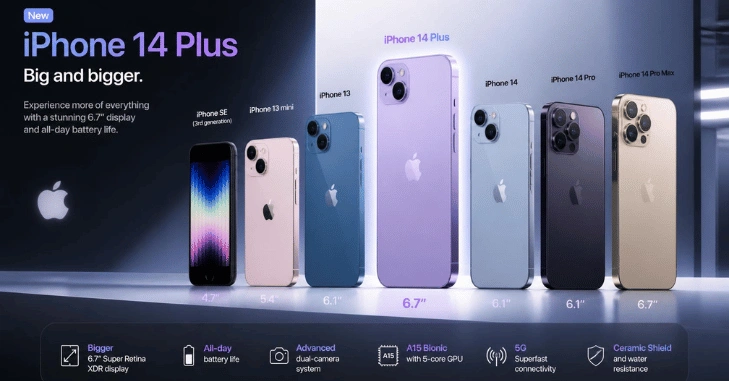
Your real comparison is not against other used phones. It is against the cheapest new iPhone you could buy instead.
| Option | Price | Screen | Chip | Apple Intelligence | Port |
| This model, used | $248 to $433 | 6.7-inch, 60Hz | A15 | No | Lightning |
| iPhone 17e, new | $599 | 6.1-inch | A19 | Yes. | USB-C |
| iPhone 16 line, new | From $699 | 6.1 or 6.7-inch | A18 | Yes. | USB-C |
| iPhone 17, new | $799 | 6.3-inch, 120 Hz | A19 | Yes. | USB-C |
Compared against the iPhone 17e at $599, the used option saves you roughly $300 and costs you the newer chip, USB-C, and Apple Intelligence. Compared against the iPhone 17 at $799, you give up a 120 Hz screen and a 48 MP camera system that Apple rates for up to 30 hours of video.
The size argument is the strongest one. Nothing Apple sells under $699 carries a 6.7-inch screen. If a large display is your whole reason for shopping, the math tilts hard toward buying used.
That is the trade-in in one line.
Pros and cons
- Big 6.7-inch OLED for a price no new iPhone touches
- Battery life that still beats several current models on paper
- Crash Detection and Emergency SOS via satellite hardware included
- Cheap, flat-rate battery service from Apple
- No Apple Intelligence, permanently
- Lightning port, so your USB-C cables stay in the drawer
- 60 Hz screen and a 12 MP main camera with no telephoto
- A finite update window that shortens every year
Five checks before you hand over the money
- Battery health. Ask the seller for a screenshot of Settings > Battery > Battery Health> Charging. Under 85% means you are buying a $79 repair with the phone.
- Carrier status. Confirm it is unlocked. A locked discount rarely covers the trouble of switching later.
- eSIM readiness. Every US unit is eSIM only, with no physical SIM tray. Check that your carrier supports eSIM transfer before you commit.
- Satellite window. Emergency SOS via satellite is free for only two years after activation. A phone first switched on in 2022 or 2023 has run out of that free period.
- Returns. Prefer a seller with a real returns window. Gazelle gives 30 days, and a private sale usually gives you none.
Who should buy one, and who should not
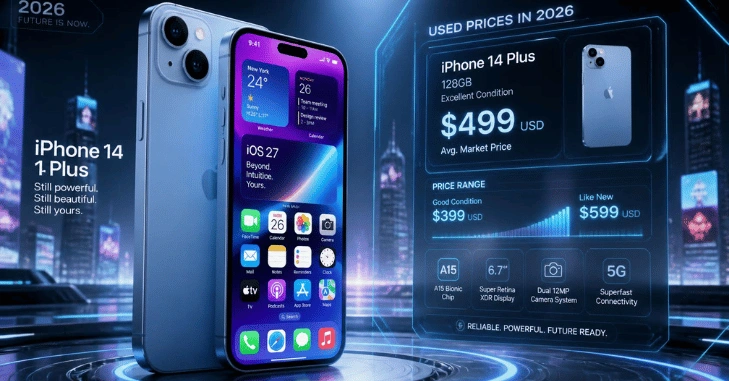
Buy it if you want the biggest possible screen and the longest possible battery for under $350, and you treat a phone as an appliance. Parents buying a first phone, second-line users, and anyone replacing a cracked older model will get real value here.
Do not buy it if you keep phones for four or five years, shoot a lot of video, or expect on-device AI features. Spend the extra $250 on a new iPhone 17e instead and start the update clock over. For more hardware explainers before you decide, browse the site’s tech guides section.
Conclusion
The iPhone 14 Plus still makes sense in 2026 if your priorities are a large 6.7-inch OLED display, strong battery life, and a used price around $300. Its A15 Bionic remains capable for everyday tasks, and confirmed iOS 27 support gives it more life than its age might suggest. However, the lack of Apple Intelligence, 60 Hz display, Lightning port, and an older camera system limits its long-term appeal. For buyers focused on value and screen size, it remains a worthwhile used iPhone; for those wanting the latest features and longer future support, a newer iPhone is the better investment. Elsewhere on the site: Why Luxury Watches Still Matter in the Age of Smartwatches.
FAQ
No. It is no longer availableonger available from Apple’s store and from Apple Certified Refurbished. Third-party marketplaces are the only source now.
It runs iOS 26 today, and Apple has confirmed it will keep getting the next release this fall.
On a well-kept unit, yes. That 26-hour video rating gives it room to age, and a worn cell costs $79 to replace.
No. Those features need an iPhone 15 Pro or an iPhone 16 and later, and that will not change.
Buy this for the 6.7-inch screen and the low price. Buy the $599 iPhone 17e instead if you want a longer support window and USB-C.