
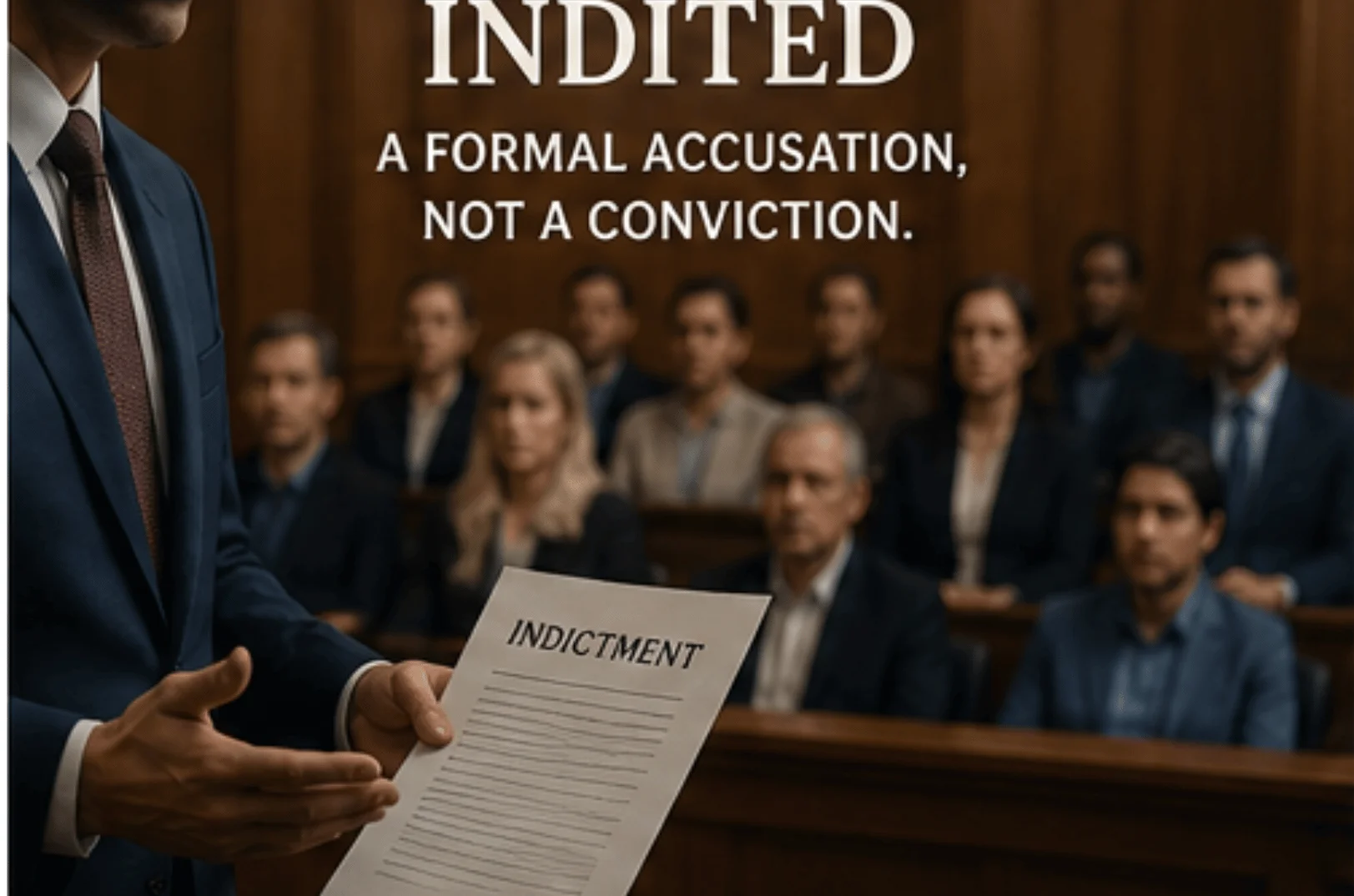
Nine times out of ten, the person typing “indited” into a search box just read the word “indicted” and did a double-take. Both words exist, and both are pronounced the same way. Only one has anything to do with a courtroom, and it is not this one. The indited meaning is simply “composed” or “wrote down,” the past tense of the old verb indite.
So if you met the word in a news story about a criminal case, you almost certainly met a typo. If you met it in a hymn, a poem, or an old letter, you met the real thing.
| Quick facts | Detail |
|---|---|
| Word | indited (past tense and past participle of indite) |
| Part of speech | Transitive verb |
| Pronunciation | in DYTE, rhyming with “excited” minus the ex |
| Core sense | Composed, wrote, put into words |
| Other forms | indict, indicts, indicting, indictment |
| Age | In English since the 1300s |
| Register | Archaic and literary, rare in everyday writing |
| Modern substitute | wrote, composed, penned, drafted |
Indited meaning in plain English
To indite something is to compose it and set it down in words. A poet indites a sonnet. A clerk indites a letter. This verb carries a faint air of care and ceremony, so it suits a hand-copied manuscript better than a text message. Its past tense means the writing already happened.
Two shades of sense sit inside that one definition. The first is invention, meaning you made the thing up out of your own head. The second is transcription, meaning you took the words down on paper. Older writers used both freely, which is why one person might dictate a letter that another person set down. Also worth reading: Definition of Fidelity.
Why do “indite” and “indict” trip people up
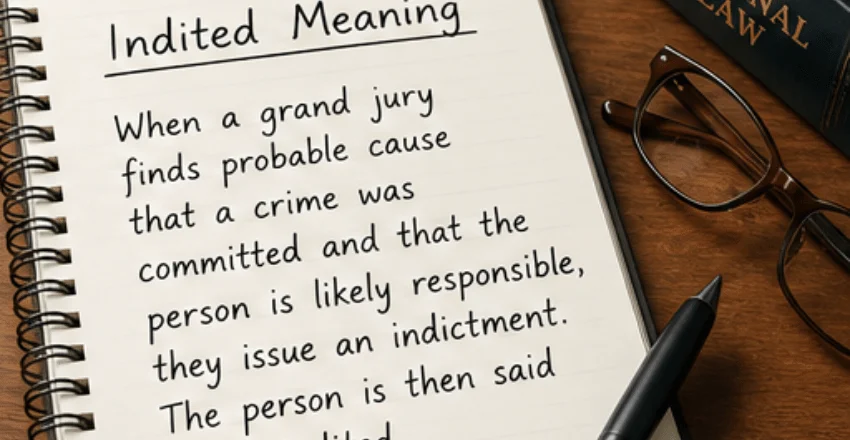
Here is the odd part. The confusion is not really about spelling at all, because both words sound identical. “Indict” is pronounced in DYTE, with the “c” staying completely silent. Say the two aloud, and nobody could tell you which one you meant. That shared sound is not a coincidence. Both words came into English from the Anglo-French “enditer,” which traces back to the Latin “indicere,” meaning to proclaim or declare formally.
English took the writing sense first, around the 14th century. Roughly two hundred years later, scribes with a fondness for Latin respelled the legal branch with a c to show off its ancestry. That letter went onto the page and never made it into anyone’s mouth. So English ended up with two words, one sound, and a silent consonant nobody asked for. Readers meeting an unfamiliar term hit this kind of snag constantly. It is the same shrug people give the cultural context behind oi oi oi baka before the phrase finally clicks.
Indict vs. indict, side by side
| indite | indict | |
|---|---|---|
| Means | To compose or write down | To formally accuse someone of a crime |
| Past tense | indited | indicted |
| Noun form | indictment | indictment |
| Typical setting | Poetry, scripture, old correspondence | Grand juries, court reporting, headlines |
| How common | Very rare | Everyday news vocabulary |
The one question that settles it
You do not need to memorize either etymology. Ask yourself one thing: is a crime involved?
- Crime, a grand jury, a prosecutor, an arraignment: the word is “indicted,” with a c.
- Words on a page, a poem, a letter, a psalm: the word is indited, no c.
Run that test on any sentence, and it resolves in about a second. “The senator was indicted on three counts” fails the test immediately because counts belong to a courtroom. Someone dropped the “c,” and spellcheck let it through because the result is a genuine dictionary word.
Autocorrect deserves some of the blame here. Phone keyboards accept both spellings without complaint, so a dropped ‘c’ sails through unflagged into a text, a caption, or a comment thread. Search engines then see thousands of people asking about a word they never meant to type.
Where this word still turns up

Most people who encounter the real verb meet it in the King James Bible. Psalm 45 opens with the line “My heart is inditing a good matter,” which readers have been puzzling over since 1611. Church hymnals kept it circulating for centuries after that.
That line simply means “my heart is composing something good,” which is a gentler thought than most modern readers expect from a psalm. Translators after 1611 swapped in plainer verbs, so newer Bibles lose the word entirely.
Beyond scripture, it shows up in three places:
- Nineteenth-century letters and diaries, where the verb sat in its natural habitat.
- Poetry and literary criticism, where the word signals composition as craft rather than typing.
- Crossword puzzles and vocabulary tests, which love a short word with a silent trap in its cousin.
Outside those corners, the verb has quietly retired. Word survival follows no obvious logic. Some terms fade while new coinages spread across the internet in months, which is roughly the story behind the FAFO acronym and its jump into mainstream speech.
Using indite and indited in a sentence
Real examples make the sense stick faster than any definition. Each of these uses the verb correctly:
- She indited a long apology and then never mailed it.
- The monk spent his winters inditing manuscripts by candlelight.
- He indites his speeches by hand before anyone else sees them.
- Whoever indites the minutes should also sign them.
Swap “wrote” for any of those, and the meaning survives intact. That interchangeability is exactly why the word faded. English rarely keeps two verbs doing identical work, and “wrote” is shorter, plainer, and understood by everybody.
Should you use it in your own writing?
Usually, no. Reach for it, and most readers will assume you misspelled “indicted,” which slows them down instead of informing them. Your reader ends up studying the spelling instead of your point. There are fair exceptions. Historical fiction earns it. So does deliberate wordplay, or an essay about scripture where the archaic register matches the subject.
Outside those, plain verbs win. Anyone writing for a web audience learns this early. That same instinct sits behind what an on-page SEO service includes, where plain wording and the reader’s own vocabulary drive results.
What to do when you find it in a document
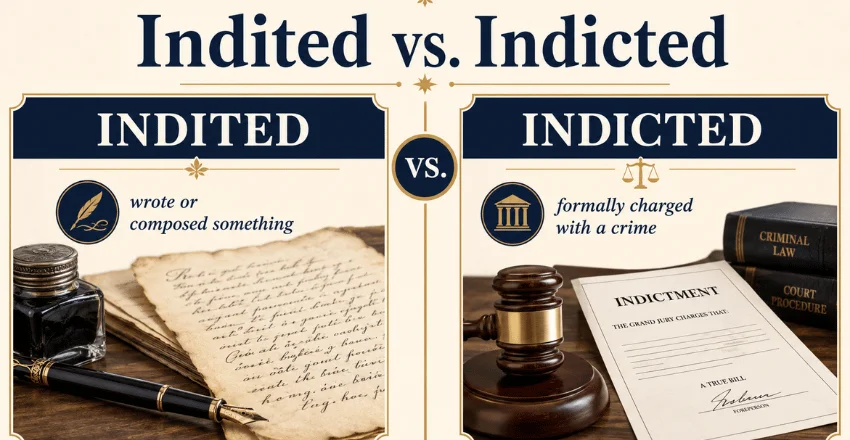
Context decides. In a court filing, an arrest report, or a news story about a prosecution, “indited” is a mistake for “indicted,” and you can read it that way with confidence. Nobody has ever been indited by a grand jury, because grand juries do not compose poetry.
In a literary or religious text, take it at face value. Someone wrote something. If you are quoting old material, keep the original spelling and add a note rather than silently correcting an author who meant precisely what they wrote.
TL;DR
- Indited is the past tense of “indite,” an old verb meaning “composed” or “wrote down.”
- Indite and indict sound identical, both said as DYTE.
- Only indictment belongs to criminal law, so a crime in the sentence means you need the c.
- Most online sightings of the word are simply misspellings of indicted.
- In your own writing, “wrote” or “composed” will serve you better.
Your next step
Say the sentence out loud, then ask whether a crime is anywhere in it. That single check will get you the right spelling every time, without a dictionary. Keep it handy the next time a headline makes you look twice, and browse our other word explainers whenever a phrase stops you mid-sentence.
Frequently asked questions
It has none. The legal term is “indicted,” spelled with a c. If a filing or article uses that spelling, treat it as a typing error and read it as indicted.
Yes. Major dictionaries still list it, marked as archaic or literary. Being rare and being wrong are different things, and this word is only the first.
No. Both are said in DYTE. The “c” in “indicted” is silent, which is exactly why the two get confused in writing rather than in speech.
An indictment is a piece of writing, the noun matching indict. An indictment is a formal criminal accusation. One letter separates them, along with an entire subject area.
It reached English in the 1300s through Anglo-French “enditer,” from the Latin “indicere,” meaning to declare or proclaim. Indict branched off the same root about two centuries later.
No, and doing so will read as an error to anyone who knows the difference. Use “indicted” when a crime is involved and save “indite” for composition.