

Public Relations (PR) is the strategic work of earning attention, building trust, and managing relationships between an organization and the audiences it depends on, from customers and employees to reporters, investors, regulators, and local communities. Unlike advertising, where a company pays for and controls the message, PR relies heavily on earned attention through media relationships, credible storytelling, expert communication, and timely responses.
In 2026, effective Public Relations goes beyond generating press coverage; it connects communication activities to measurable outcomes, reputation, audience trust, crisis readiness, and broader business goals.
Short answer: think of the function as earning attention and trust from the groups an organization depends on: reporters, customers, staff, investors, regulators, and neighbors. The team pitches stories, briefs spokespeople, builds relationships and answers hard questions. Because none of that coverage is bought, none of it is fully controlled.
The practice areas, mapped to audience and scoreboard
One label covers six fairly different jobs. They share a method, persuasion through a third party, and not much else. Each answers a different audience, is triggered by a different signal, and is judged by a different number.
| Public Relations Practice Area | Audience | Key Activities | Common Trigger | How Public Relations Is Measured |
| Media relations | Reporters, editors, trade press, podcasters | Story pitches, exclusives, data studies, executive briefings, the occasional press release | A launch, a milestone, research worth reporting | Coverage in target outlets, message pull-through, referral traffic, branded search lift |
| Crisis and issues | Everyone at once: customers, staff, media, regulators | Holding statement, single spokesperson, live monitoring, direct posts | Recall, outage, data breach, viral complaint, executive misconduct | Time to first response, share of coverage carrying your facts, sentiment recovery, customer retention |
| Internal and employee | Staff, managers, frontline teams | All-hands sessions, manager toolkits, intranet posts, short video notes | Layoffs, restructuring, a merger, a new strategy, a policy change | Read rates, pulse survey scores, message recall, voluntary attrition |
| Investor relations | Shareholders, analysts, financial press | Earnings scripts, quarterly calls, guidance, regulatory filings | Results day, a funding round, an acquisition, a profit warning | Analyst understanding of the story, accuracy of coverage, fewer surprises at results |
| Community relations | Neighbors, local officials, nonprofits | Local sponsorship, open days, volunteering, grant programs | A new site, an expansion, a closure, a local complaint | Local sentiment, planning approvals, partner sign-ups, volunteer hours |
| Public affairs | Legislators, regulators, civil servants, advocacy groups | Consultation responses, coalitions, position papers, hearings | A proposed rule, a license renewal, a new standard, an industry inquiry | Policy outcomes, meetings secured, whether your evidence shows up in the final rule |
TL;DR
- The work earns coverage rather than buying it, so it can shape a story without ever guaranteeing one.
- Advertising rents attention, marketing sells a product, and this function manages relationships and reputation.
- Six practice areas cover media, crisis, employees, investors, communities, and policy, each with its own scoreboard.
- Advertising value equivalency is no longer used as a metric. Outcomes and business contribution replaced it.
- The Bureau of Labor Statistics counted 315,900 US PR specialist jobs in 2024, at a median wage of $69,780.
Advertising, Marketing, Communications, and Public Relations Are Three Different Jobs
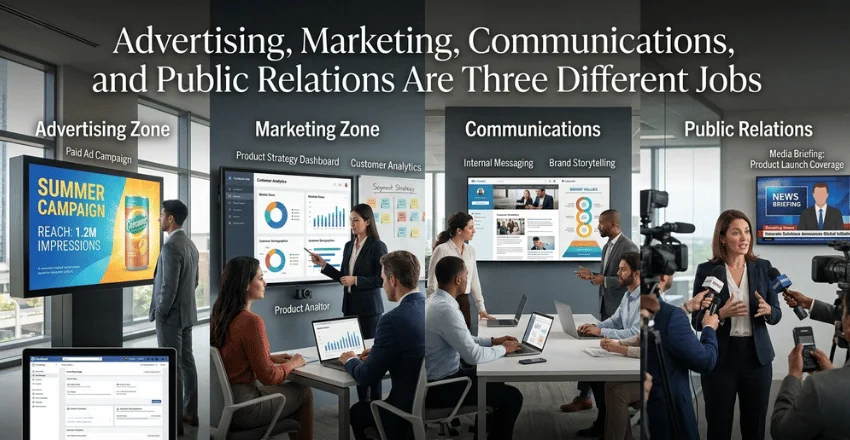
Marketing owns the commercial question: what to sell, to whom, at what price, and through which channel. Advertising is one thing marketing buys, while public relations works alongside marketing and communications to build relationships, earn attention, and influence what people believe about an organization before they ever see a price. Split them by who controls the message.
| Paid | You do, word for word | Media budget, priced per impression or click | Readers know it is an ad and discount it accordingly |
| Owned | You do, on your own site and feeds | Production time | Trusted for detail, distrusted for judgment |
| Earned | A journalist, an analyst, or a customer does | Relationships, plus a story worth telling | Someone independent put their name on it |
Public relations lives in that third row, which is why it is powerful and uncomfortable to buy. Business news sections are built almost entirely from earned material. Nothing in our business coverage ran because a company paid for it.
What the six areas look like on a Tuesday
Media relations is mostly research and reading. Good practitioners know which reporter covers which beat, what that reporter published last month, and what they are sick of being pitched. A press release is one tool here, useful for the record and for wire pickup, and nowhere near the most valuable one.
Crisis work is the opposite of that patient rhythm. It is quiet for months, then it eats a weekend. Internal communications is the area most companies underrate. Staff read the same feeds as everyone else, so if they learn about a layoff from a news alert, you have already lost the room. Telling employees first is a sequencing decision, not a courtesy.
Investor relations runs on a calendar, not on news judgment. Quarterly results anchor everything, and disclosure rules set hard limits on what can be said and when. Earnings, funding rounds, and acquisitions are the raw material, and anyone who follows that reporting will recognize the pattern from our finance news section.
Community relations is the least glamorous and often the most decisive. Distribution centers get built or blocked on relationships formed years earlier. Public affairs does the same work at a bigger scale, turning a company’s evidence into something a regulator can use.
How public relations is measured in 2026
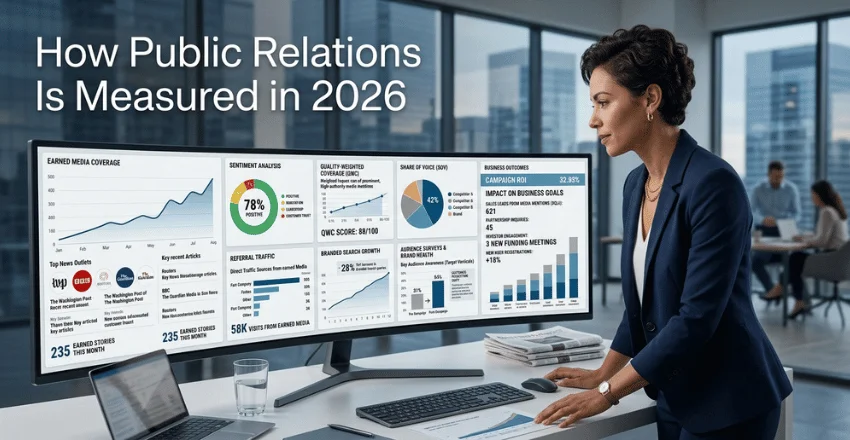
For decades, the industry measured itself with advertising value equivalency. That method counted the column inches of a story and priced them as though you had bought an ad the same size. It was a comforting number and a nonsense one. It measures what media space costs, not what the coverage did, and it quietly assumes an ad and an article are worth the same to a reader.
That verdict is now formal. AMEC, the industry’s measurement body, published the Barcelona Principles in 2010 and has since issued a fourth edition. One principle states flatly that advertising value equivalents are not the value of communication. That document pushes practitioners toward outcomes rather than raw output counts, and toward methods transparent enough that someone else could repeat them.
What a serious 2026 report contains instead:
- Outcomes, not clippings. What moved in awareness, understanding, attitude, or behavior among a named group.
- Quality-weighted coverage. Was it a target outlet? Did it carry your message? Was the tone right? Did a spokesperson appear?
- Digital response. Referral traffic, branded search volume, and direct visits in the days after a placement.
- Share of voice on chosen issues, measured against named competitors rather than against the whole market.
- Survey tracking—periodic polling of the audience that matters, which is the only honest read on trust.
- Business contribution, modeled alongside every other channel rather than claimed in isolation.
Anyone still selling you a single dollar figure for last month’s coverage is selling you the old number in new packaging.
Crisis response now starts on a phone, not in a newsroom.
The old model assumed a reporter would call, and that a company had until the evening bulletin to decide what to say. That window is gone. A customer films something in a store, posts it, and the story is established before any journalist gets involved. By the time a reporter does call, they are asking you to respond to a narrative you had no part in shaping.
Three things follow from that. Deleting a post does not remove it, because screenshots outlive the original. Silence for six hours reads as guilt to an audience used to instant replies. And speed without facts reads as spin, which is worse than saying little.
Good practice is a short acknowledgment that buys time honestly. It confirms you know, says what you are doing, gives a time for the next update, and speculates about nothing. Behind it sits monitoring that flags unusual volume, a decision chain agreed before the bad day, one named spokesperson, and an employee message that goes out first.
The career and agency picture

The Bureau of Labor Statistics tracks PR specialists as their own occupation and counted 315,900 US jobs in 2024, with a median wage of $69,780 in May 2024. It projects 5 percent growth through 2034, faster than the average across all occupations, and roughly 27,600 openings a year. Managers earn considerably more, with a 2024 median of $132,870. The BLS also warns that competition for entry-level roles is strong.
Employers are more varied than the agency stereotype suggests. Education leads at 14 percent of these jobs, ahead of agencies at 13 percent and government at 10 percent. On the buying side, 2026 agency pricing guides commonly quote boutique retainers of $3,000 to $7,000 a month. Mid-market firms run $8,000 to $15,000, and national or global firms start near $20,000. Most ask for three to six months, and they are right to do so: media relationships do not compress.
In-house teams cost more up front and less in ramp-up time. Freelancers work well for a single launch and badly for a crisis. Companies that want to gauge which stories break through can scan our featured stories before briefing anyone.
Where to start
Pick the trigger you are facing, find its row in the table above, and write down the audience and the measure before anyone picks a tactic. A launch and a data breach need completely different teams. Getting that order right separates a program that reports numbers from one that moves them.
Frequently asked questions
It is the work of getting other people to say something accurate and favorable about you, without paying them to say it. That covers reporters, analysts, employees, regulators, and customers.
Sometimes on the org chart, rarely in practice. Marketing aims at buyers and revenue. Communications teams also answer to staff, investors, regulators, and communities, none of whom are buying anything.
Reading, mostly. Then writing pitches, briefing spokespeople, checking facts with legal, monitoring coverage, and answering reporter questions on deadline. The visible output is a small fraction of the hours.
US retainers commonly range from about $3,000 per month at a boutique firm to $20,000 or more at a global firm. Expect a minimum of three to six months.
According to the BLS, a bachelor’s degree is the typical entry point, often in communications, business, or a social science. Certification helps with some employers and is not required. Published work in a portfolio matters more than either.