
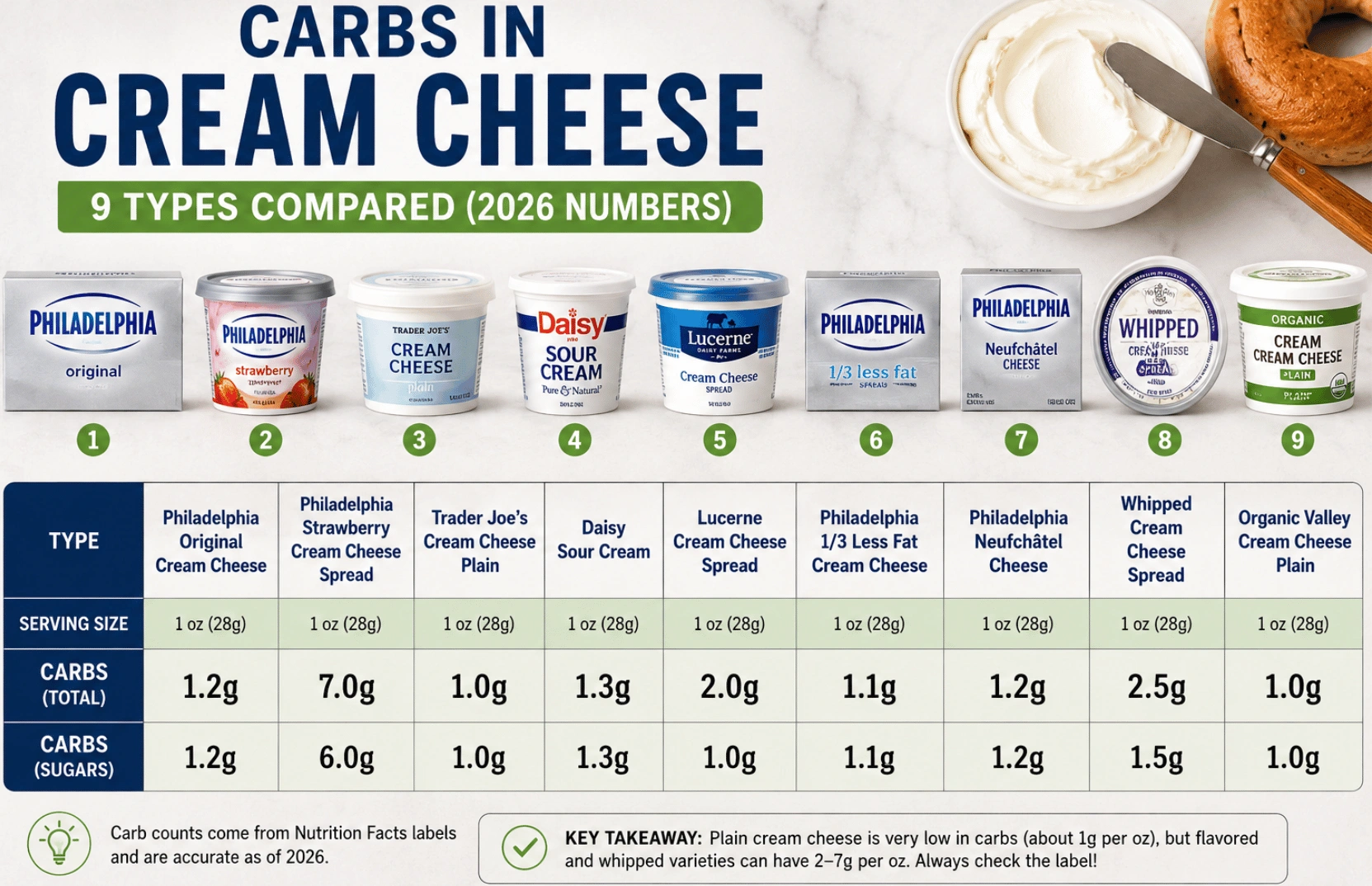
A plain brick and the strawberry tub beside it are not the same food on a carb tracker. The carbs in cream cheese vary by a factor of four across the dairy case, and the Nutrition Facts panel is the only place that shows it.
Below are nine products sold in American supermarkets, each with its own label serving weight. The carbs in cream cheese also sit low enough that a federal rounding rule reshapes what the panel prints, which is where most guides stop short.
Quick answer: Plain full-fat cream cheese carries roughly 1.3 to 1.6 grams of carbohydrate per ounce, or about 0.7 grams per tablespoon. Philadelphia’s brick label declares 1 gram per 28-gram serving. Fat-free tubs climb to 3 grams per serving, and sweetened strawberry spread reaches 5 grams.
The Numbers at a Glance
Every figure below comes from a current Nutrition Facts panel or from USDA reference data. Column four is ours. We divided each label figure by its own serving weight, then scaled it to a common ounce, because no two of these tubs use the same portion.
| Product | Label serving | Total carbs (label) | Per 1 oz (28 g) | Sugars | Calories |
| Plain, generic (USDA SR Legacy) | 1 oz (28 g) | 1.6 g | 1.6 g | 1.1 g | 99 |
| Philadelphia Original brick | 1 oz (28 g) | 1 g | 1.0 g | 1 g | 100 |
| Philadelphia 1/3 Less Fat (Neufchatel) | 1 oz (28 g) | 1 g | 1.0 g | not listed | 70 |
| Philadelphia Reduced Fat Tub | 2 tbsp (31 g) | 2 g | 1.8 g | 2 g | 60 |
| Philadelphia Whipped Original | 2 tbsp (22 g) | 2 g | 2.5 g | 1 g | 50 |
| Philadelphia Fat Free | 2 tbsp (33 g) | 3 g | 2.5 g | 2 g | 30 |
| Philadelphia Strawberry spread | 2 tbsp (32 g) | 5 g | 4.4 g | 5 g | 70 |
| Violife Just Like Original (vegan) | 2 tbsp (30 g) | 2 g | 1.9 g | 0 g | 70 |
| Kite Hill Plain (almond) | 2 tbsp (33 g) | 2 g (1 g fiber) | 1.7 g | 1 g | 70 |
Key Takeaways
- Plain full fat is the lowest per gram, at roughly 1.3 to 1.6 grams of carbohydrate per ounce.
- Fat-free is the highest unsweetened option, near 3 grams per 33-gram serving.
- Sweetened flavours such as strawberry run four to five times a plain brick, almost entirely from sugar.
- Label serving weights range from 22 to 33 grams, so per-spoon figures are not comparable.
- A deli-sized schmear adds 4 to 6 grams of carbohydrate, a fair slice of a 20-gram keto day.
Carbs in cream cheese, ounce by ounce
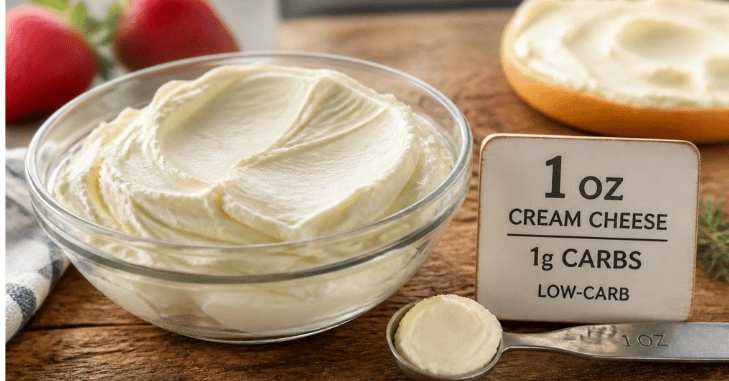
USDA keeps two reference entries for this food, and they do not agree. Carbs in Cream Cheese: The SR Legacy record lists 5.5 grams of carbohydrate per 100 grams. Its FNDDS record, built from national food survey data, lists 4.6 grams per 100 grams.
Convert both, and you get a range rather than a single truth.
- Per 100 grams: 4.6 to 5.5 grams
- One ounce (28 g): 1.3 to 1.6 grams
- Per tablespoon (about 15 g): 0.7 to 0.8 grams
- A whole 8-ounce brick: 10 to 13 grams
Anyone quoting this to two decimal places is selling false precision. Milk supply, culture, and finished moisture all shift the result from batch to batch, which is exactly why USDA’s own two datasets land a gram apart.
What That Means on a Keto Day
Most keto plans cap total carbohydrates somewhere between 20 and 30 grams a day. Against that ceiling, a tablespoon is a rounding error. Two tablespoons of celery run well under a gram and a half. A bagel schmear is another matter. Delis routinely apply three to four ounces, which lands between 4 and 6 grams of carbohydrate before the bagel itself joins the tally.
That single portion can eat up a quarter of your daily allowance. So weigh it once. Whatever habit fixes your protein target fixes this one too. Our fitness and training coverage rests on the same idea: measure a portion properly one time, then trust your eye.
Why does the panel say 1 gram and the USDA says 1.6?
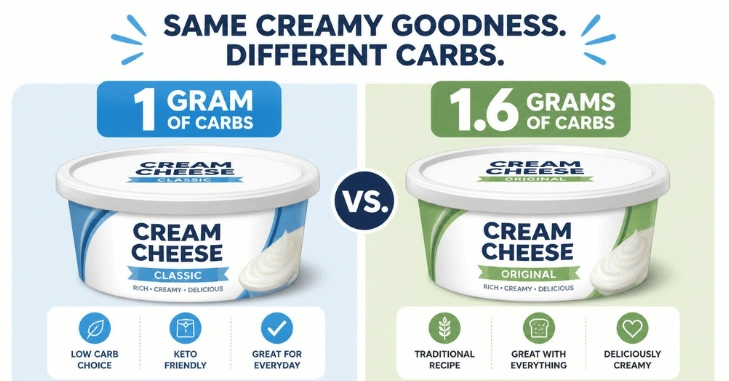
Philadelphia’s brick declares 1 gram per 28-gram serving. USDA’s generic entry works out to about 1.6 grams of carbohydrate for that same serving weight. Both statements can be honest at the same time.
Rounding covers most of the gap. According to the FDA labeling rule at 21 CFR section 101.9(c)(6), a serving holding less than 0.5 grams of carbohydrate may be declared as zero. Anything under 1 gram of carbohydrate may be shown as “less than 1 gram” on the label instead. A tub printing 0 g is therefore not proof of a carb-free food.
Recipe variation explains the rest. Brands differ, and the USDA figure averages a lot of them. Four ounces of a spread whose label declares “0 g” could legally hold close to 2 grams of carbohydrate. On a 20-gram carb day, that matters.
Serving weights change from tub to tub.
This catches more people than the carb count itself does. Philadelphia’s brick uses a 28-gram serving. Whipped Original uses a 22-gram serving, because air has replaced part of the volume. Fat Free uses 33 grams, and so does Kite Hill. Two tablespoons is not a fixed weight anywhere; it is whatever each maker chose to print.
Here is where the table earns its keep. Whipped looks like the light choice at 50 calories and 2 grams per serving. Scaled to an ounce, it carries 2.5 grams of carbohydrate, more than the brick it was churned from.
Which Type Is Lowest, and Why Does Fat Help?
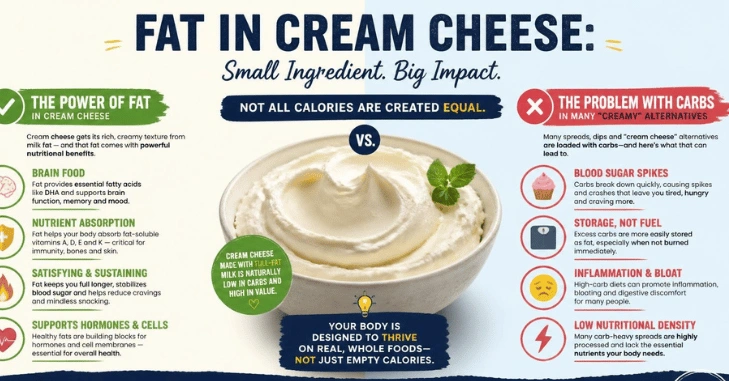
Full fat wins, and the reason is structural. The FDA standard of identity for this product requires at least 33 percent milkfat and no more than 55 percent moisture. Fat crowds out the milk solids that carry lactose, so the richest version holds the fewest sugars per gram.
Take the fat out and something has to fill the space. In fat-free tubs, that filler is skim milk, gums, and stabilizers, which pushes the panel up to 3 grams per serving while calories fall to 30.
Flavoured spreads sit at the top of the range. Philadelphia’s strawberry version declares 5 grams of carbohydrate per 2-tablespoon serving, all 5 of them sugars, with 3 grams added during manufacture.
Sugar, Lactose, and Blood Sugar
There is sugar in the plain version, and it is lactose left over from the cream. It accounts for nearly all of the carbohydrates on the panel. Dairy versions carry no fibre, so total carbs and net carbs are the same number.
Dose matters, and this one is small. A 2-tablespoon serving of the plain brick holds roughly 1 gram of lactose, which is why plenty of people who avoid milk still tolerate this spread.
For readers managing diabetes, the plain versions behave gently on a cracker, and the fruit spreads do not. Treat it as a portion question, not a yes or no question, and let your dietitian or care team set the number that suits your medication and targets.
Plant-Based Tubs
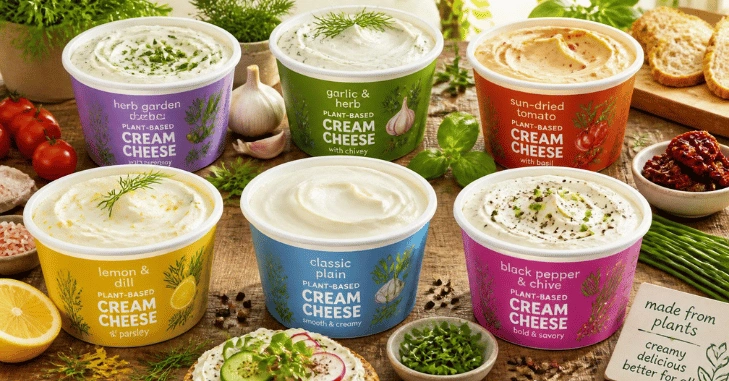
Vegan versions start from coconut oil, almonds, or cashews, so their numbers do not track the dairy ones at all. Violife Just Like Original declares 2 grams of carbohydrate per 30-gram serving with 0 grams of sugar. Kite Hill Plain declares 2 grams per 33-gram serving, but 1 of those is fibre, which leaves about 1 gram net. Check the panel anyway, because some almond and cashew tubs lean on tapioca or potato starch and push past 5 grams per serving. More everyday food swaps sit in our lifestyle and food guides.
What To Do Next
Pull your tub out of the refrigerator and read two things: the serving weight in grams and the total carbohydrate line. Carbs in Cream Cheese: Then weigh one normal knife load on a kitchen scale once, and note the number. Most people find their usual portion is closer to three tablespoons than two. Save the table above, check any new brand against the per-ounce column, and you can stop guessing at breakfast.
Frequently Asked Questions
Two tablespoons of the plain, full-fat kind delivers about 1.5 grams. Three or four of those portions still fit inside a 20-gram carb day. Watch the flavoured tubs instead.
Both the Original Brick and the 1/3 Less Fat Neufchatel declare 1 gram per 28-gram serving, which suits nearly any low-carb plan. Fat-free, and the fruit spreads are harder to fit.
Yes. Butter sits near zero. An ounce of the plain spread at 1.3 to 1.6 grams of carbohydrate is still far below an ounce of jam, which runs past 20 grams.
Per spoonful, yes, because you get less food. Whipped Original declares 2 grams per 22-gram serving, so gram for gram it is slightly higher than the brick.
No. Heat does not remove carbohydrates. A cheesecake’s carbs come from the sugar and the crust, not from the dairy layer.