

If you wonder, do dogs remember people after a long separation, research points to yes. Dogs can recognize familiar humans through scent, voice, faces, and learned associations. The exact length of that recognition is not fixed by science. For American pet owners, the practical takeaway is that recognition is real, but exact timelines remain uncertain.
Quick answer: Dogs can remember familiar people, especially those tied to repeated care, safety, play, and routine. They identify humans through several cues, including smell, voice, and facial information. Research supports long-term recognition, but science does not provide a single number for how long a memory lasts.
| Question | What research suggests |
|---|---|
| Can dogs recognize familiar people? | Yes, studies support recognition through scent, voice, and faces. |
| Is smell important? | Yes. Familiar human scent can produce distinct brain responses in dogs. |
| Can dogs recognize a voice? | Yes. Dogs can match familiar voices with the correct person. |
| Can dogs recognize a face? | Yes. Dogs have recognized owners from photographs in controlled tests. |
| How long does recognition last? | No single duration has been established for every dog. |
| Can aging affect recognition? | Yes. Sensory decline and cognitive dysfunction can change behavior. |
Key takeaways
- Recognition has stronger evidence than claims about human-like autobiographical memory.
- Scent, voice, facial cues, routines, and emotional associations can all matter.
- Research does not support a precise memory expiration date for every dog.
- A quiet reunion does not automatically mean a dog forgot someone.
- Sudden recognition problems in an older dog deserve veterinary attention.
How Do Dogs Remember People?
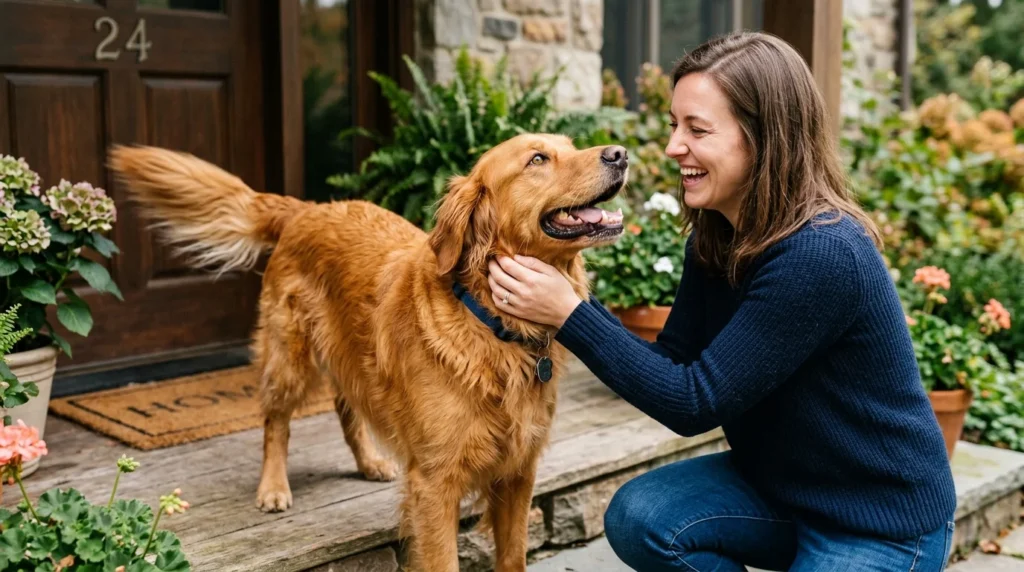
Dogs don’t rely on a single cue to identify a familiar human. They combine smell, sound, sight, context, and past learning. That layered system helps explain why recognition can survive changes in clothing, hairstyle, or location.
Scent can carry a strong familiarity signal
A 2015 brain-imaging study tested 12 awake dogs with five different scents. Familiar human scent produced the strongest caudate response among the tested odors. Researchers connected that response with positive expectation and familiarity.
The familiar person was not present during the scent test. That detail matters because recognition did not depend on seeing the person. A known smell alone was enough to produce a different brain response.
Dogs can identify familiar human voices
Dogs also use voices as identity cues, not only as commands. A 2025 study found dogs could match familiar speakers with their voices. The results support individual recognition of humans through sound.
Earlier work also found that dogs expected an owner’s face after hearing that owner’s voice. Dogs looked longer when the voice and face did not match. That experiment suggests dogs can connect identity information across different senses.
Faces can also support recognition
Visual information matters even though smell often receives more attention. In a 2020 experiment, 60 pet dogs chose between owner and stranger photographs. Dogs selected their owners above chance under the tested conditions.
The study showed that the task did not require a live person. Motion and three-dimensional information were also unnecessary under those conditions. A still photograph could provide enough information for recognition.
What Kind of Memory Do Dogs Use?
Dog memory includes several systems, so one simple label can be misleading. Learned associations are especially important in everyday life. Dogs can connect people with food, walks, safety, play, stress, or other repeated outcomes.
That is why training often strengthens predictable associations between cues and results. Newslibe’s guide to choosing a dog and trainer discusses consistent handling and training choices. Clear routines can make learned responses easier to maintain.
| Memory question | What evidence supports | What remains uncertain |
|---|---|---|
| Recognizing a familiar person | Supported through scent, voice, and face studies | Recognition strength varies by dog and situation |
| Associating a person with outcomes | Supported by learning and recognition research | The exact emotional content cannot be verbally confirmed |
| Recalling a specific past event | Episodic-like recall has been demonstrated experimentally | Human-like autobiographical memory has not been established |
Dogs also show episodic-like memory
Scientists have also tested whether dogs remember unexpected past actions. In a 2016 study, trained dogs watched a person perform an action. They later reproduced the action when unexpectedly asked to imitate it.
Dogs succeeded after one-minute and one-hour delays, although performance declined with time. Researchers described the result as evidence for episodic-like memory. They use that term carefully because animals cannot verbally describe their memories.
How Long Can a Dog Remember a Person?
There is no scientifically established countdown for how long a dog remembers someone. Research tasks usually measure controlled recognition or recall under specific conditions. They do not follow every dog-person relationship across an entire lifetime.
Long-term recognition is still plausible when a relationship was repeated and meaningful. Familiar scent, voice, routines, and emotional associations can provide several retrieval cues. A reunion may activate more than one cue at once.
Even brief learning can sometimes create useful recognition. A 2024 study found free-ranging dogs learned to recognize a rewarding person. They needed four interactions across four days in that experiment.
The study shows that repeated experience can build individual recognition quickly. It does not prove every dog will remember every visitor for years. Memory strength depends on the dog, the relationship, and later circumstances.
What Makes Recognition Stronger After Time Apart?
Several factors can make a familiar person easier to recognize after a separation. None works as a guaranteed memory formula for every animal. Together, they explain why some reunions look immediate while others unfold slowly.
- Repeated contact: Frequent interactions give the dog more chances to learn a person’s cues.
- Positive associations: Care, play, food, and safety can create strong learned connections.
- Distinct scent: Familiar odor can remain informative even without visual contact.
- Recognizable voice: Vocal patterns can help identify a familiar speaker.
- Familiar context: A known home, car, yard, or routine can support recognition.
- Health and age: Hearing, vision, smell, pain, and cognition can affect responses.
Don’t treat a dog’s greeting style as a perfect memory test. Some dogs jump, vocalize, or wag intensely. Others sniff first, pause, or approach more slowly.
Signs a Dog May Recognize Someone
Recognition can appear through attention and changes in behavior. Look for a cluster of responses instead of one dramatic sign. A wagging tail alone can reflect excitement, arousal, or uncertainty.
- Turning quickly toward a familiar voice.
- Approaching after hearing or smelling the person.
- Relaxed body posture after an initial inspection.
- Repeated sniffing followed by friendly social behavior.
- Seeking contact, play, or a familiar routine.
- Looking between a familiar person and expected locations or objects.
Context matters because stress can suppress an otherwise familiar response. Travel, boarding, veterinary visits, or crowded rooms can change greeting behavior. Give the dog time to gather scent, sound, and visual information.
Why a Dog May Seem Not to Remember You
A muted greeting doesn’t mean memory has disappeared. The dog may be tired, anxious, distracted, in pain, or overwhelmed. Changes in your scent, voice, clothing, mobility, or surroundings can also alter recognition cues.
Aging deserves special attention because sensory and cognitive changes can affect familiar behavior. The American Animal Hospital Association lists disorientation and altered social interaction among the signs of cognitive dysfunction. Memory loss and reduced recognition can also occur in affected senior dogs.
AAHA guidance recommends veterinary evaluation for concerning changes in older dogs. Pain, sensory loss, neurological disease, and other illnesses can produce similar behavior. A veterinarian can help separate memory concerns from medical causes.
Can You Help a Dog Remember You?
You cannot control exactly what a dog stores or retrieves. You can make your interactions consistent, calm, and predictable. Repeated positive experiences give the animal more reliable cues to associate with you.
Use the same name, voice style, and familiar activities when appropriate. Let a returning dog approach at its own pace instead of forcing contact. Familiar routines often provide clearer information than an excited greeting ritual.
For broader care topics, browse Newslibe’s pet care guides. The site’s cat paw health guide also shows why knowing normal behavior matters. A personal baseline makes unusual changes easier to notice.
Frequently Asked Questions
Do dogs remember people after years apart?
They can recognize important people after long separations, but research gives no universal year limit. Strong relationships provide many cues, including scent, voice, appearance, and routine. A cautious reunion can still involve recognition, especially when the setting feels unfamiliar.
Can dogs recognize a person by smell?
Smell is one documented route for recognizing familiar humans. Brain-imaging research found a distinct reward-related response to familiar human scent. Dogs also combine odor with other information, so scent is not the only cue.
Can dogs remember someone who treated them badly?
Dogs can form negative associations with people, places, handling styles, and situations. That does not prove human-like recollection of a detailed past episode. A fearful reaction may reflect learned association, current body language, or several cues together.
Can an older dog forget familiar people?
Yes, older dogs can develop conditions that affect learning, memory, and social recognition. Cognitive dysfunction is one possible cause, but sensory loss and pain can look similar. Discuss new behavior changes with a veterinarian rather than assuming they’re normal aging.
The Bottom Line
Current evidence says familiar humans can remain recognizable through several sensory and learned cues. Science is less certain about a fixed duration or human-style personal memories. That distinction is more accurate than claiming every dog remembers someone forever.
If a healthy dog needs time during a reunion, allow calm sniffing and familiar interaction. If a senior dog suddenly stops recognizing close family members, contact a veterinarian. Continue with Newslibe’s pet resources for more practical animal-care guidance.